ClComms 2014 Keynote Speaker
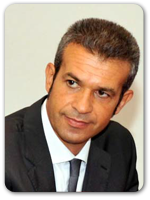
Andrea Massa
Talk Title: Dealing with Complexity in Optimization Design
ABSTRACT
In the last decades, the extraordinary growth of the computational capabilities has led to suppose that any problem, despite its complexity, could be effectively dealt with by means of generic numerical optimization strategies. However, many times such techniques are used as "black-box" tools without an adequate knowledge of their peculiarities and functionalities. Therefore, sub-optimal solutions can be obtained or the achievement of reliable solutions prevented, especially when dealing with the optimization of complex functionals.
In order to avoid these drawbacks, starting from the knowledge of the physics of the problems at hand and the available a-priori information, the choice of the most suitable approach is a crucial point enabling the effective retrieval of the problem solution.
In this talk, a review of the most recent techniques developed at the ELEDIA Research Center and suitable to deal with functional complexity in engineering electromagnetics is presented. In particular, indications will be given about the use of optimization techniques, based on Evolutionary Algorithms (EAs), able to find the global best solution when optimizing - min/max - a cost function; Learning-by-Example (LBE) approaches (e.g., SVM, ANN) suitable for regression or classification; Compressive Sensing (CS) techniques, adapt for reducing the sampling rate when representing signals as well as for reconstructing the original signals from the samples.
SHORT CV
Andrea Massa received the "laurea" degree in Electronic Engineering from the University of Genoa, Genoa, Italy, in 1992 and Ph.D. degree in EECS from the same university in 1996. From 1997 to 1999, he was an Assistant Professor of Electromagnetic Fields at the Department of Biophysical and Electronic Engineering (University of Genoa). From 2001 to 2004, he was an Associate Professor at the University of Trento. Since 2005, he has been a Full Professor of Electromagnetic Fields at the University of Trento, where he currently teaches electromagnetic fields, inverse scattering techniques, antennas and wireless communications, wireless services and devices, and optimization techniques.
At present, Prof. Massa is the director of the ELEDIA Research Center at the University of Trento with a staff of more than 25 researchers. Moreover, he is Adjunct Professor at Penn State University (USA) and he has been Visiting Professor at the Missouri University of Science and Technology (USA), at the Nagasaki University (Japan), at the University of Paris Sud (France), at the Kumamoto University (Japan), and at the DigiTEo (Paris – France).
Prof. Massa serves as Associate Editor of the "IEEE Transaction on Antennas and Propagation" and Associate Editor of the "International Journal of Microwave and Wireless Technologies" and he is member of the Editorial Board of the "Journal of Electromagnetic Waves and Applications", and a permanent member of the "PIERS Technical Committee" and of the "EuMW Technical Committee". He has been appointed in the Scientific Board of the "Società Italiana di Elettromagnetismo (SIEm)" and elected in the Scientific Board of the Interuniversity National Center for Telecommunications (CNIT). Recently Prof. Massa has been appointed by the National Agency for the Evaluation of the University System and National Research (ANVUR) as a member of the Recognized Expert Evaluation Group (Area 09, 'Industrial and Information Engineering') for the evaluation of the researches at the Italian University and Research Center in the period 2004-2010. Moreover, he has been appointed as the Italian Member of the Management Committee of the COST Action TU1208 "Civil Engineering Applications of Ground Penetrating Radar".
His research activities are mainly concerned with direct and inverse scattering problems, propagation in complex and random media, analysis/synthesis of antenna systems and large arrays, design/applications of WSNs, cross-layer optimization and planning of wireless/RF systems, semantic wireless technologies, material-by-design (metamaterials and reconfigurable-materials), and theory/applications of optimization techniques to engineering problems (telecommunications, medicine, and biology).
Prof. Massa published more than 500 scientific publications among which about 250 on international journals and more than 270 in international conferences where he presented more than 50 invited contributions. He has organized 45 scientific sessions in international conferences and has participated to several technological projects in the European framework (10 EU Projects) as well as at the national and local level with national agencies (40 Projects/Grants).